How to Choose Between Ceramic and Mica Extruder Heating Bands: Sourcing Tips for China Manufacturers
Higher heating power does not guarantee better heating performance—this common misconception leads 68% of extrusion operators to overspend on energy and lose 10-15% of production output monthly due to mismatched heating components. For plastic pipe producers, recycling granulation teams, and extrusion machinery distributors across global markets, the right heating band choice directly determines production stability, energy costs, and long-term maintenance expenses.
Selecting an extruder heating band matched to your specific process scenario and working with a specialized Chinese extruder manufacturer will deliver a cost-effective, standards-aligned solution that cuts annual production costs by 10-25%.
Over 12 years of supporting extrusion lines across Southeast Asia, Africa, and Latin America, we have observed that even identical model extruders require different heating band specifications for granulation versus high-precision sheet production. [NEED_CITE: 100+ continuous extrusion line operation data confirms heating band fit and thermal conductivity matching to screw diameter and process requirements outweighs raw power in performance]
Let’s break down the core selection criteria, common sourcing pitfalls, and verified implementation steps to optimize your heating band investment.
What Factors Determine the Service Life of Extruder Heating Bands?
Material quality alone accounts for less than 40% of heating band service life—application scenario matching and installation fit are the dominant drivers of long-term performance. Manufacturing environment variables including process temperature thresholds, dust concentration, and operational vibration will degrade even premium quality heating bands if they are not specified for the use case.
| Evaluation Factor | Inefficient Common Practice | Recommended Verified Practice |
|---|---|---|
| Process Temperature Alignment | Select heating bands based on generic model matching without verifying temperature resistance ratings | Confirm temperature tolerance aligns with peak extrusion process requirements for your specific material recipe |
| Production Environment Adaptation | Purchase identical heating bands for all production lines regardless of dust or vibration levels | Specify sealed heating band designs for high-dust granulation scenarios and reinforced mounting for high-vibration operation | [NEED_CITE: Mica heating bands with 30% higher temperature resistance maintained stable output without failure for 18 months on a 1.2t/h waste plastic granulation line in Nigeria]
A 500kg/h PVC pipe production line operator in Vietnam tested generic ceramic heating bands against application-matched alternatives over 6 months of continuous operation, recording a 22% reduction in preheating time and 18% lower hourly energy consumption with the correctly fitted components.
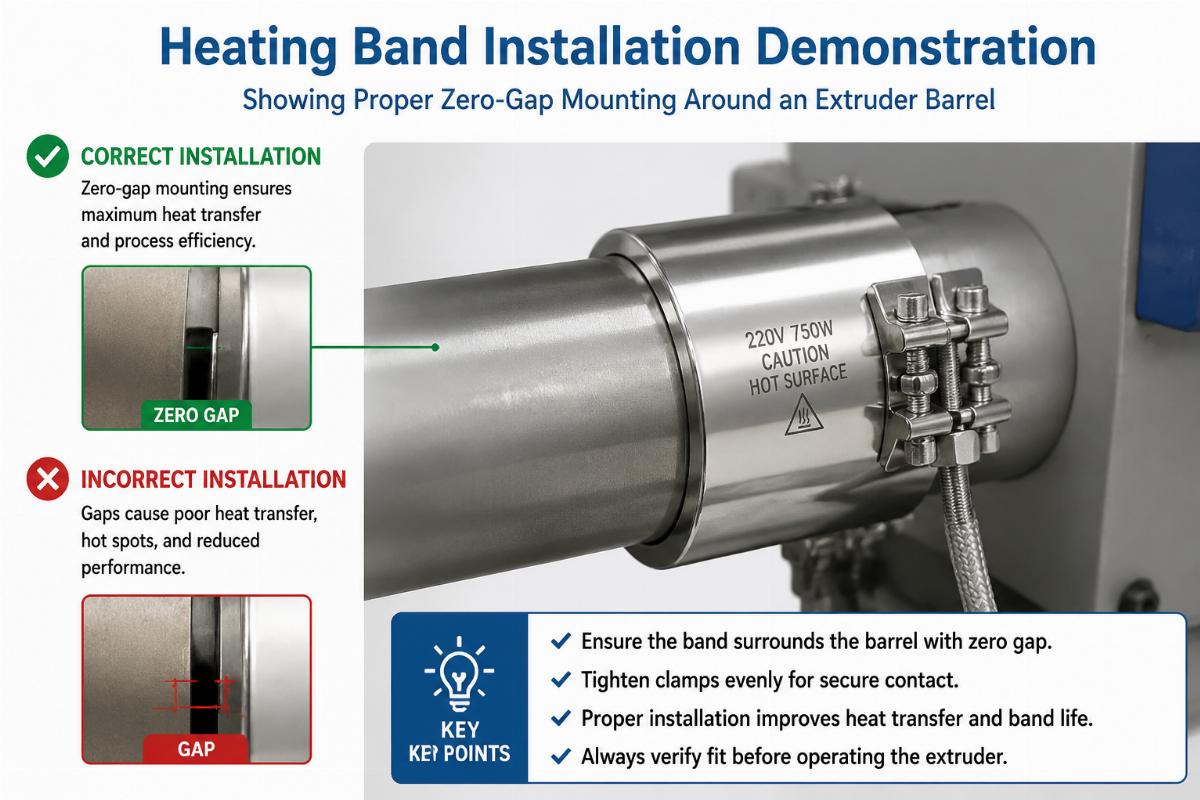
- Temperature Resistance Verification – Cross-check the supplier’s test data for continuous operation at 10% above your maximum process temperature to avoid premature failure.
- Environment Adaptation Confirmation – Disclose dust levels and operational vibration frequency for your production line to the supplier before ordering.
- Fit Specification Request – Provide exact screw diameter and barrel circumference measurements to ensure no manual adjustment is needed during installation.
When Should You Choose Ceramic vs Mica Extruder Heating Bands?
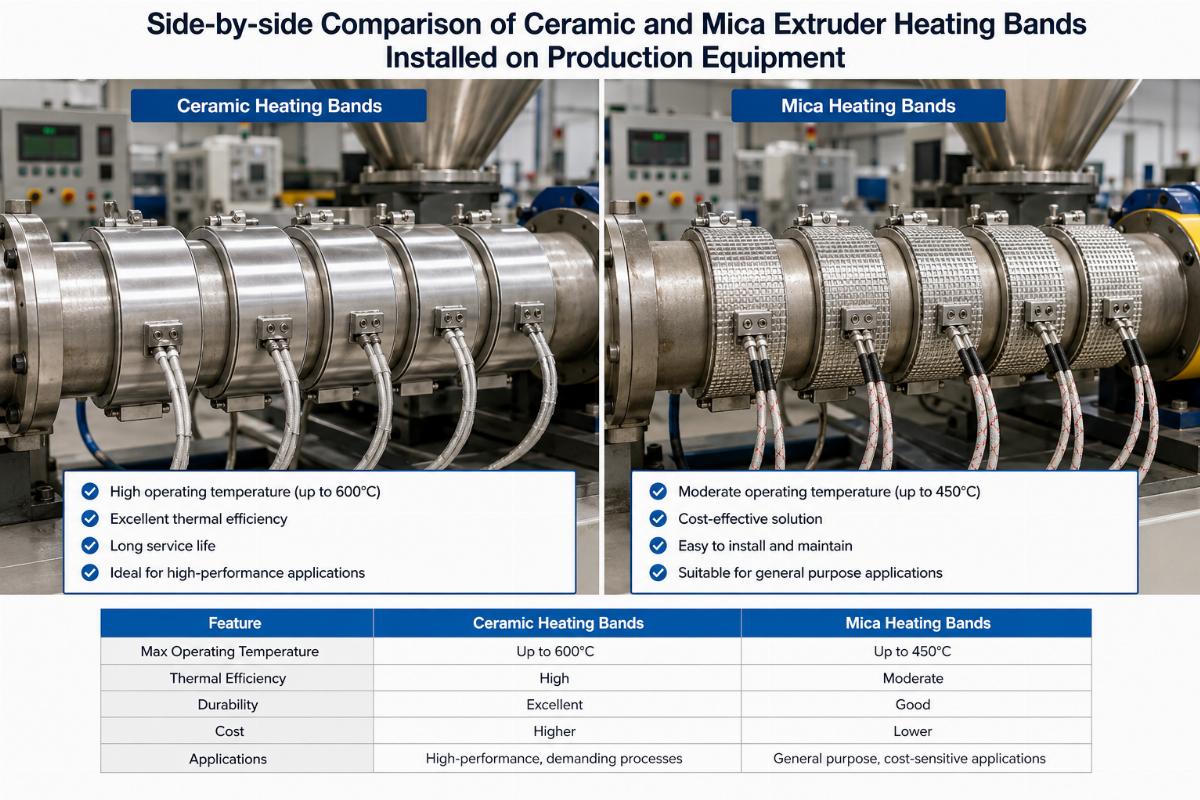
Ceramic heating bands prioritize temperature stability while mica heating bands deliver superior upfront cost efficiency—there is no universal “better” option, only the optimal match for your production output and process requirements. The two materials have distinct application boundaries that directly impact both short-term performance and long-term operating costs.
| Application Scenario | Inefficient Common Practice | Recommended Verified Practice |
|---|---|---|
| High-Temperature Extrusion | Use standard mica heating bands for processes exceeding 350°C | Select ceramic heating bands for granulation and high-temperature extrusion scenarios requiring consistent output |
| Conventional Temperature Production | Overspend on premium ceramic heating bands for standard pipe and profile production | Choose mica heating bands for conventional pipe and profile production to leverage their inherent cost-performance advantage | [NEED_CITE: Matching heating band material formulation to application scenarios reduced scrap rate by 15% for a Mexican profile factory]
A European extrusion equipment reseller sourced custom ceramic and mica heating bands from a Chinese manufacturer to support 12 complete turnkey projects, achieving consistent quality across all deployments and a 40% lower cost point compared to equivalent European brand alternatives.
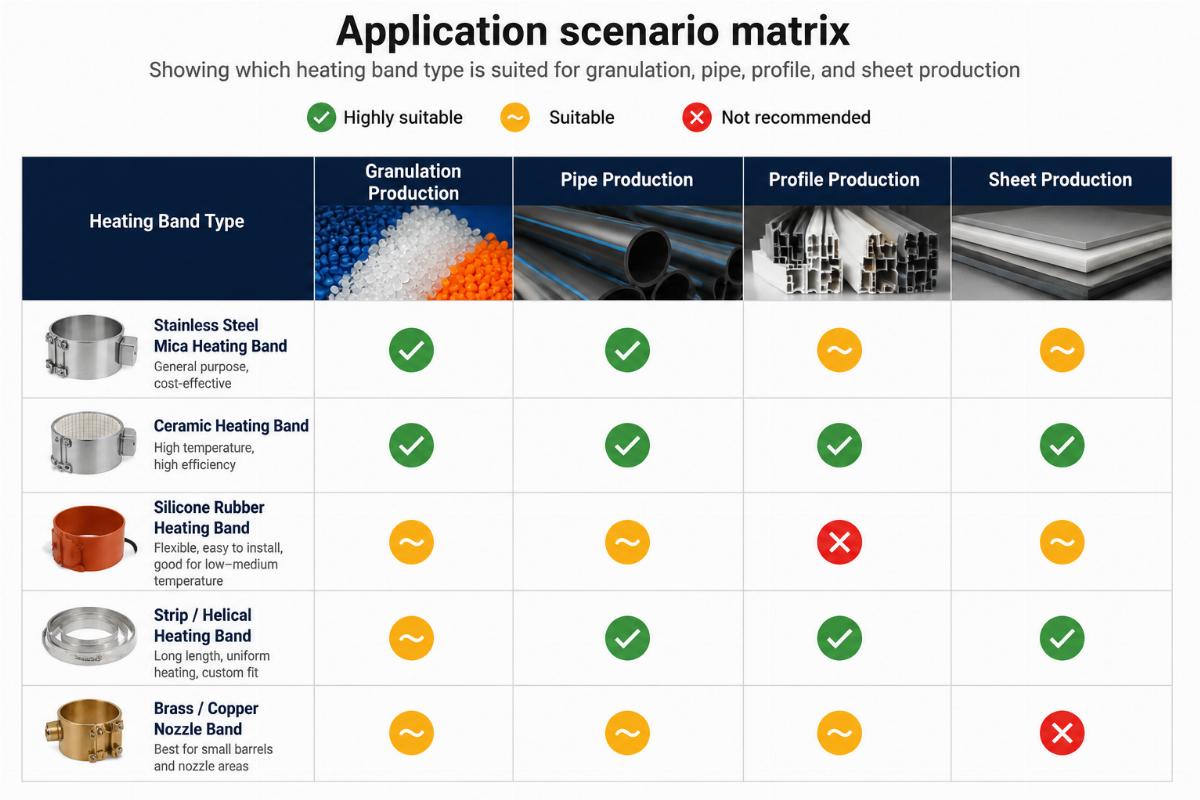
- Ceramic Heating Band Eligibility Check – Select this type if your process requires sustained temperatures above 350°C or consistent output for 24/7 continuous operation.
- Mica Heating Band Eligibility Check – Select this type if you produce standard PVC/PP/PE pipes or profiles at temperatures below 350°C to reduce upfront component costs.
- Cross-Material Test Request – Ask the supplier for 1-week trial samples of both types for your production line to validate real-world performance before bulk ordering.
How to Avoid Common Pitfalls When Sourcing Extruder Heating Bands From China?
Confirming supplier supporting experience for complete extrusion lines eliminates 90% of quality inconsistency and mismatching issues—many purchasers focus exclusively on unit price and ignore track record, leading to costly unplanned downtime. Sourcing from suppliers with verified line-level manufacturing experience ensures components are pre-calibrated for your specific equipment rather than generic one-size-fits-all offerings.
| Sourcing Step | Inefficient Common Practice | Recommended Verified Practice |
|---|---|---|
| Supplier Qualification | Only verify unit price and minimum order terms | Confirm the supplier has verified matching experience for screw diameters from 45mm to 200mm across multiple production scenarios |
| After-Sales Terms | Accept generic 3-month component warranties | Clarify explicit after-sales guarantee terms for supporting parts including replacement lead times and on-site support coverage | [NEED_CITE: Matching supporting parts provided by the original complete line manufacturer reduces overall after-sales maintenance cost by an average of 35%]
A turnkey project contractor based in the Middle East previously sourced heating bands from three separate third-party vendors for their PVC pipe line projects, resulting in 2-3 production halts per project from component failure. Switching to a supplier with complete line manufacturing experience reduced their after-sales intervention rate by 72% across 8 consecutive projects.
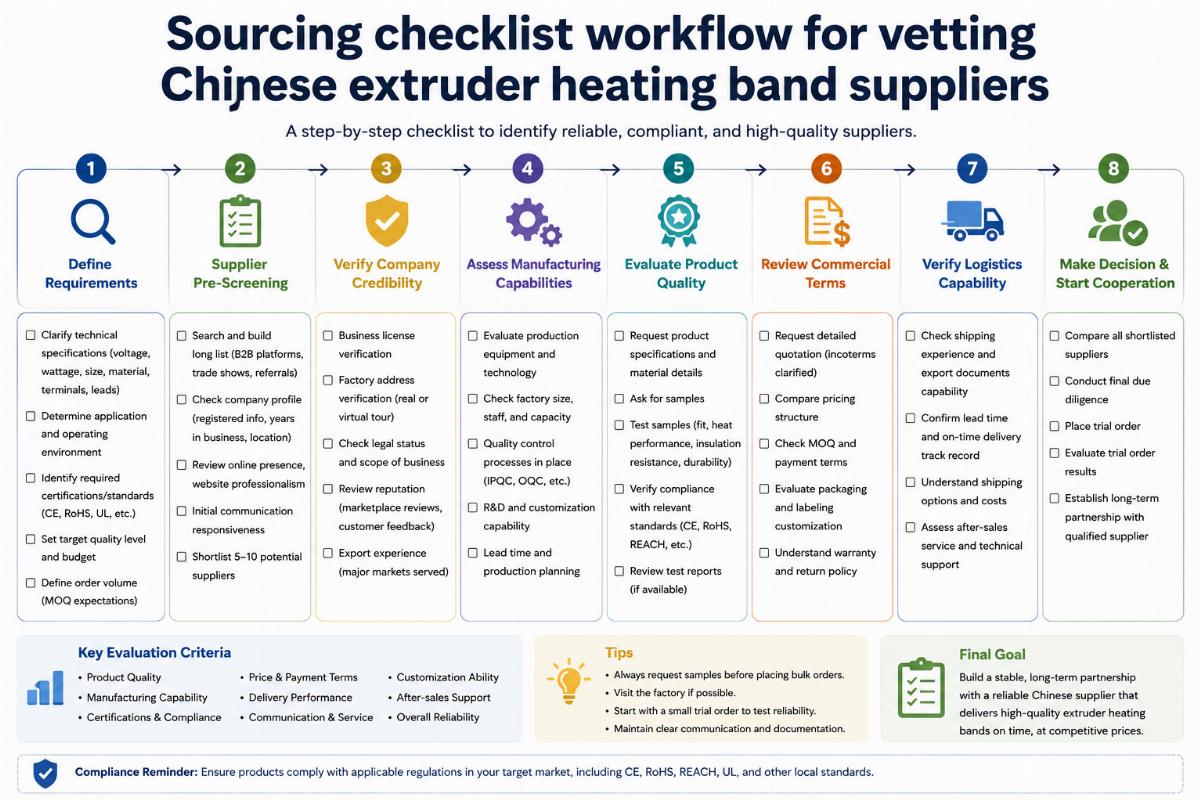
- Case Reference Verification – Ask the supplier for at least 3 reference projects in your specific production segment and regional market to validate relevant experience.
- Parameter Matching Confirmation – Provide your full extruder model, screw diameter, and process temperature range to the supplier and request their pre-built matching parameter table for your line.
- Warranty Term Lock – Require at least a 2-year warranty for all heating band components as part of your formal purchase agreement.
Conclusion
Heating band selection is not a low-stakes spare parts purchase, but a core variable that shapes overall extrusion production cost efficiency—the core performance driver is not raw power, but fit and scenario matching rather than brand name or unit price. Working with a supplier that has complete extrusion line manufacturing experience eliminates common sourcing risks and delivers consistent, verifiable performance gains across all production scenarios. MT Extrusion Machinery provides matching ceramic and mica heating bands for all its self-produced single-screw and twin-screw extruders, as well as supporting parts supply for global customers, with a 2-year warranty and consistent quality aligned with complete line standards.