
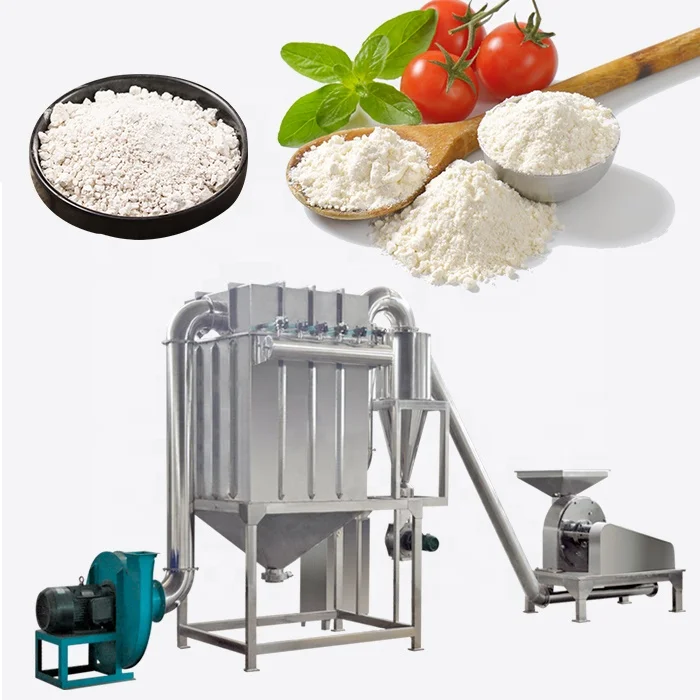


MT65 / MT70 / MT85 Nutritional Powder Processing Line, Twin-Screw Extrusion, 85-195KW Installed Power — configured for baby food, infant cereal and fortified grain powder production from rice, corn and beans.
Screw configuration and barrel temperature profile are matched to your grain formula and target powder density, with throughput verified across extruder, roaster and milling stations to prevent line bottlenecks.
- Trial runs on your actual raw material completed in our testing workshop before shipment
- Turnkey delivery from batching to packing under one supplier with matched station capacity
- On-site installation, commissioning and operator training included with ongoing maintenance support
Description
Verified Output on Your Formula — We run your exact grain and protein blend in our testing workshop before building the line, so capacity claims match what actually happens on your factory floor.
Technical Specifications
| Parameter | Value |
|---|---|
| Product Type | Nutritional Powder Processing Line |
| Model Options | MT65 / MT70 / MT85 |
| Extruder Type | Twin-screw (Double Screw) |
| MT65 Installed / Real Power | 85 kW / 65 kW |
| MT70 Installed / Real Power | 120 kW / 90 kW |
| MT85 Installed / Real Power | 195 kW / 165 kW |
| MT65 Output Capacity | 150–200 kg/h (basis to be confirmed on raw material and moisture) |
| MT70 Output Capacity | 200–300 kg/h (basis to be confirmed on raw material and moisture) |
| MT85 Output Capacity | 600–800 kg/h (basis to be confirmed on raw material and moisture) |
| MT65 Dimensions (L×W×H) | 18000 × 1300 × 2300 mm |
| MT70 Dimensions (L×W×H) | 20000 × 1500 × 2400 mm |
| MT85 Dimensions (L×W×H) | 24000 × 3500 × 4300 mm |
| Extruder Main Motor Power | 30 kW |
| Extruder Actual Power Consumption | 30–35 kW |
| Extruder Dimensions (L×W×H) | 2800 × 830 × 1875 mm |
| High-Temp Roaster Output | 300–400 kg/h |
| High-Temp Roaster Effective Belt Length | 3.5 m |
| Roaster Far Infrared Heater Power | 3.9 kW × 24 units |
| Roaster Gas Consumption | 6.8 m³ |
| Powder Mixer Tank Volume | 150 kg |
| Powder Mixer Rotary Speed | 385 rpm |
| Powder Mixer Cycle Time | 10 min per batch |
| Construction Material | Stainless steel 304 on food-contact surfaces |
| Compliance | CE, ISO |
Application Suitability
| Application | Material or Output |
|---|---|
| Baby rice cereal and infant porridge powder | Rice, corn, and mixed grain blends |
| Fortified nutritional powder for institutional feeding programmes | Grain bases blended with vitamins, minerals, and protein isolates |
| Sesame paste and soybean powder | Oil-rich seeds and legumes requiring controlled roasting |
| Modified starch for textile and papermaking | Corn and cassava starch requiring pregelatinisation |
| Pregelatinised flour for building materials and oil drilling | Grain flours requiring specific gelatinisation and expansion profiles |
Why "300 kg/h" Can Mean Almost Nothing on a Nutritional Powder Line
A capacity number without your raw material attached is not a capacity — it is a guess.
I learned this the hard way early in my career setting up a nutritional powder line in a factory down in the Pearl River Delta. We had trialed the twin-screw extruder on standard rice flour at the workshop, and the numbers looked solid. But the client’s actual formula was heavy on whey protein isolate. When we fired it up on-site, the gelatinisation collapsed, and the bulk density of the finished powder drifted almost a third away from spec. We spent two full weeks reconfiguring screw elements and rewriting the barrel temperature curve before the line stabilized. [NEED_CITE: protein content effect on extrusion gelatinisation behaviour]
That is why every nutritional powder processing line we build starts with your actual formulation. The MT65, MT70, and MT85 platforms each cover a different throughput band, but the real output you will see depends entirely on what you are feeding it — the grain type, the protein and fat content, the incoming moisture, and the target particle size after milling.
Screw Configuration Matched to What You Are Actually Extruding
A twin-screw extruder is only as capable as the screw profile loaded into its barrel. For a baby food production line running predominantly rice with moderate protein, a forward-conveying screw arrangement with moderate shear delivers consistent gelatinisation without burning the starch. Shift to a formula loaded with soy or whey, and the same screw setup will struggle — the material sticks, the residence time goes wrong, and you get lumps and inconsistent expansion that your downstream mill cannot correct.
We configure the screw elements and die geometry specifically to the grain blend and nutritional profile you intend to run. This is not a catalogue choice — it is a calculation based on your formula sheet and confirmed in a physical trial.
Roasting and Milling Stations That Keep Pace With the Extruder
The bottleneck on many nutritional powder lines is not the extruder itself — it is the station immediately downstream. An extruder pushing material faster than the roaster belt can dry it means product piles up, cools unevenly, and enters the mill at inconsistent moisture. The mill then produces powder with variable particle size, and your blending station receives an unpredictable feed.
On this turnkey nutritional powder plant, the high-temperature roaster with its 3.5-meter effective belt length and 24 far-infrared heater elements is matched to the extruder throughput so that material moves continuously without queuing. The powder mixer at 385 rpm with 10-minute batch cycles then blends the milled powder with heat-sensitive additives — vitamins, probiotics, minerals — without thermal degradation. [NEED_CITE: post-extrusion nutrient retention in infant formula processing]
Reading the Specs That Actually Matter
The extruder main motor at 30 kW drives the screw shafts, but real power consumption between 30 and 35 kW tells you what the line draws during steady-state production — important for sizing your electrical supply. The installed power figures for the complete MT65 (85 kW), MT70 (120 kW), and MT85 (195 kW) include every motor, heater, and conveyor on the line, which is what you need for your transformer and distribution panel calculation.
The roaster gas consumption at 6.8 m³ reflects the thermal energy needed to bring extruded material to the correct moisture before milling. If your site gas supply is limited or your local fuel costs are high, this number directly affects your operating cost per kilogram. The stainless steel 304 construction on all food-contact surfaces meets the sanitary expectations for infant and baby food production, and the 150 kg tank volume on the powder mixer sets your batch size for additive blending.
The Cost of Skipping a Trial Run
When a line ships without being tested on your actual raw material, the first real trial happens on your floor — with your installation crew standing by, your packaging supplier waiting, and your market launch date approaching. If the screw configuration is wrong for your protein level, or the die geometry produces expansion your mill cannot handle, you face weeks of reconfiguration in a production environment instead of a workshop. [NEED_CITE: cost of unplanned commissioning delays in food processing installations]
Voltage mismatches compound the problem. If your site runs at a frequency the control system was not configured for, motor speeds drift, heater outputs shift, and the barrel temperature profile you tuned during setup no longer matches reality.
Why Buyers Source This Line From Here
The nutritional powder processing line arrives as a single integrated project — batching, extrusion, roasting, milling, blending, and packing stations all sized to each other, not sourced separately and bolted together. The screw configuration and die design are specified to your raw material and target powder specification before the extruder is assembled.
Every line goes through an in-house trial run on the customer’s actual grain formula before shipment, documented in a test report you review before the crate closes. Pre-sales engineering covers the line layout, throughput calculation, and utility planning. After shipment, installation, commissioning, and operator training are handled by the same team that built the line.
Documentation & Verification
- Line layout drawing showing throughput matching across every station from batching to packing
- Screw and die configuration record specific to your grain formula and target powder density
- Trial run report from our testing workshop run on your raw material before shipment
- Electrical schematic with voltage, frequency, and control language confirmed to your site
- CE declaration of conformity and ISO certificate for customs and regulatory clearance
- Operation and maintenance manual with wear parts list and replacement intervals
Installation, Commissioning & Support
- Site preparation guide covering floor load for the MT85 at 24-meter line length
- Dedicated circuit planning based on the 195 kW installed power requirement for the MT85 configuration
- Assembly supervision for extruder, roaster, and mill alignment on your factory floor
- First-run commissioning with screw speed, barrel temperature, and roaster belt speed set to your formula
- Operator training covering screw element changes, die swaps, and daily sanitation procedures
- Spare screw elements, dies, and mixer blades shipped with the line for your first replacement cycle
What to Include in Your Inquiry
To configure the right nutritional powder processing line for your project, we need your target product specification including particle size and bulk density, the grain and protein ingredients in your formula with typical moisture content, your required hourly or daily output, and the voltage and frequency at your production site. If you have existing milling or packing equipment that the new line must integrate with, include those details as well.
Frequently Asked Questions
Q: How is line capacity verified on my specific grain raw material and moisture level?
A: We run your actual formula through the twin-screw extruder in our testing workshop, measuring throughput, gelatinisation degree, and expansion before configuring the screw profile and roaster settings. The trial run report documents real output on your material, so the capacity figure you receive is not a generic estimate but a measured result tied to your recipe.
Q: What voltage, frequency, and control language options are available for my target market?
A: The electrical system is configured to your site supply before production begins — voltage and frequency are confirmed against your utility specification, and the control interface language is set to your operator team’s requirement. The electrical schematic is reviewed and approved during the specification stage, preventing commissioning delays caused by power mismatches.
Q: How are the extruder, roaster, and milling stations throughput-matched to prevent bottlenecks?
A: Each station is sized during the line layout stage based on your confirmed formula and target output. The roaster belt speed and heater output are calculated to handle the extruder’s actual discharge rate, and the powder mixer batch cycle is timed so blending keeps pace without material queuing or cooling between stages.
Q: Can the same line produce both nutritional baby food powder and modified starch?
A: Yes — by changing the screw element arrangement, die geometry, and barrel temperature profile, the same twin-screw extruder can shift from a baby cereal formula to a pregelatinised starch product. The changeover involves documented screw configuration swaps rather than hardware replacement, supporting multi-product production on a single line.
Q: What does the turnkey installation schedule look like from site preparation through commissioning?
A: The schedule covers floor preparation and utility routing before the line arrives, mechanical assembly and station alignment during installation, electrical connection and control system configuration, then commissioning runs where parameters are tuned to your formula. Operator training runs in parallel so your team is producing within specification by the time our engineers leave site.
Related products
-
Full Automatic Complete Baby Food Nutrition Powder Porridge Processing Production Line for Infant Nutrition Factory
¥9,500.00 Add to cart -

Organic Gluten Free Baby Rice Nutrition Powder Automatic 500kg/h Production Processing Line
¥8,238.27 Add to cart -

High Productivity New Condition Nutritious Baby Food Meal Replacement Powder Production Line
¥30.00 Select options This product has multiple variants. The options may be chosen on the product page -

Hygienic Stainless Steel Infant Rice Powder Processing Line Automatic 500kg/h Capacity PLC Controlled
¥9,500.00 Add to cart