How to Source Reliable Bimetallic Screw Extruder Wear Parts from China Wholesale Suppliers
Higher screw hardness does not directly translate to longer service life. Most buyers default to ranking component hardness as the top evaluation metric when sourcing extruder wear parts, but this common misjudgment often leads to 2x higher long-term maintenance costs for production lines running 12+ hours per day.
Partnering with an experienced Chinese bimetallic screw wholesale supplier cuts component costs by 30-50% compared to European brands, while delivering equivalent wear resistance, 2-year warranty and lifetime technical support for consistent long-run production.
Over 7 years of working with extrusion operators across Southeast Asia, Africa, the Middle East and Latin America, I have consistently seen production teams reduce unplanned downtime by 60% on average after switching to properly matched bimetallic screw solutions, [NEED_CITE: Properly matched bimetallic screw components reduce extruder unplanned downtime by 60% for continuous production lines]. Many teams also report a 15% lift in line output without full equipment upgrades, simply from adjusting screw configurations to their specific material and throughput requirements.
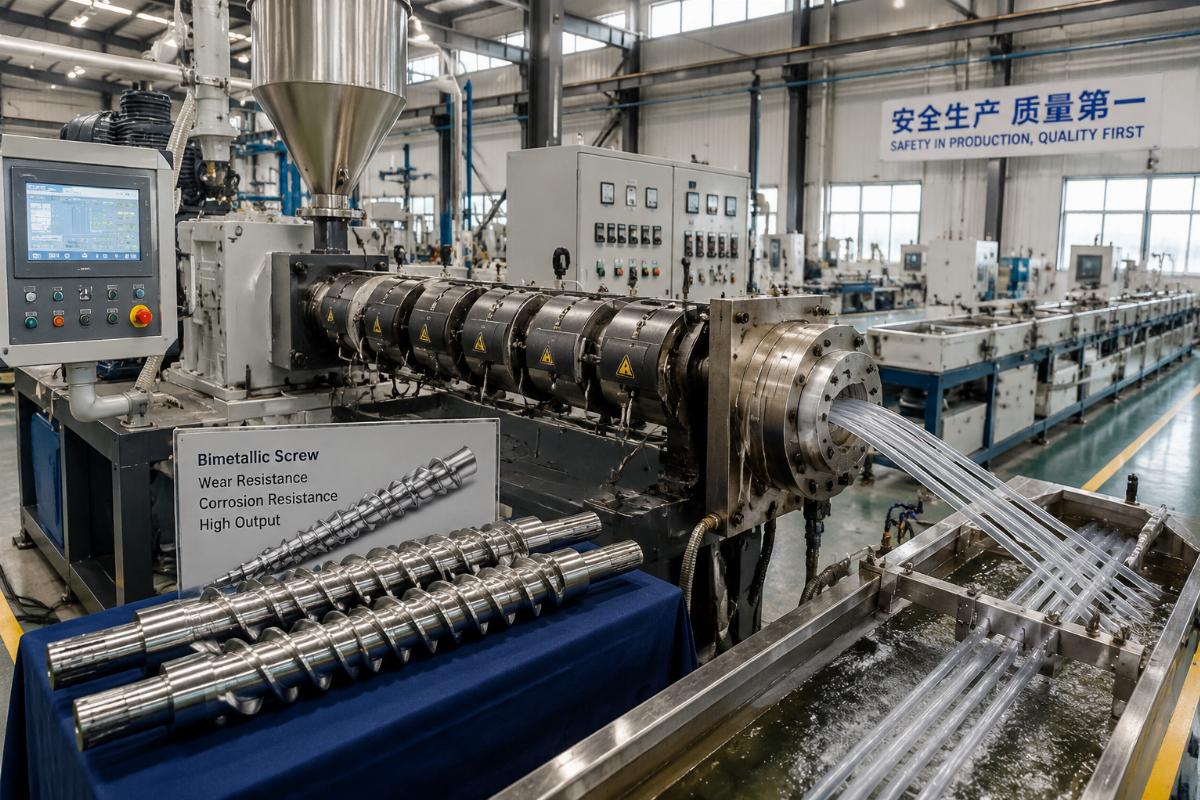
If you are tired of frequent screw replacements eating into your profit margins or quoted lead times that stretch past your project delivery deadlines, the following framework will walk you through every step to vet suppliers and select parts that fit your exact operational needs.
What core indicators should you check when selecting a bimetallic screw wholesale supplier?
Prioritize alloy formula matching capacity, production scale and after-sales support over unit price alone. Focusing only on the lowest per-unit cost often leads to parts that fail 3x faster than expected, triggering unplanned shutdowns that cost 10x the component price in lost production revenue.
| Evaluation Factor | Common Mistake | Recommended Standard |
|---|---|---|
| Core Certification | Accept only general ISO 9001 documentation without specific part-level testing reports | Require valid ISO 9001 and CE certification for extruder wear components, plus raw material alloy test certificates [NEED_CITE: CE certified bimetallic screws meet uniform international wear resistance standards for plastic processing] |
| Alloy Matching Capability | Choose suppliers that offer a one-size-fits-all alloy formula for all processing materials | Confirm suppliers can provide custom alloy formulations tailored to your specific input materials, including PVC, contaminated PE/PP film and mixed recycled plastic |
| After-sales Support | Select suppliers with no formal warranty or only 30-day return policies | Verify 2-year product warranty and lifetime technical support for all purchased components |
A regional extrusion equipment distributor based in Kenya recently ordered 12 sets of custom bimetallic screws for a turnkey 500kg/h PVC pipe project, and the supplier delivered the full batch within 45 days to match their client’s construction timeline, [NEED_CITE: Qualified Chinese bimetallic screw suppliers can fulfill 12 sets of custom bulk orders within 45 days for turnkey projects]. The distributor reported zero component failures during the first 8 months of continuous 16-hour daily line operation, with no unplanned shutdowns related to screw wear.
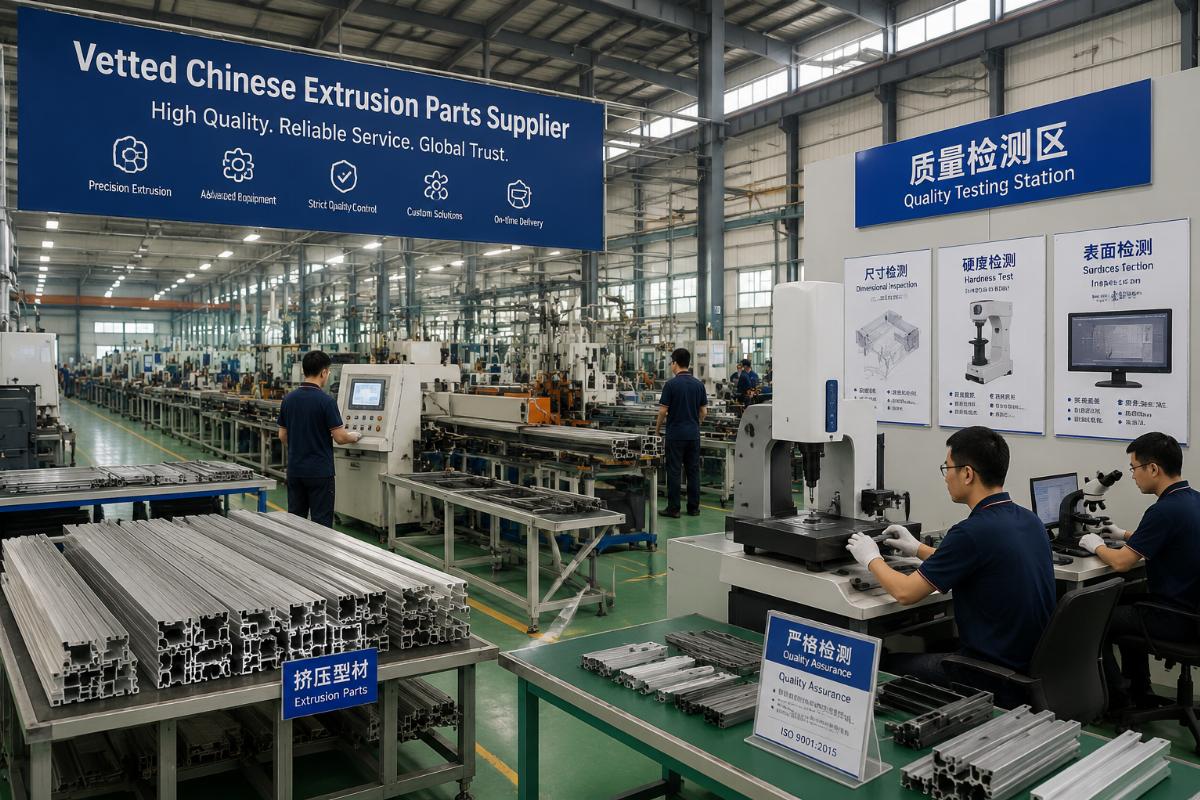
- Certification Verification – Request part-specific test reports and valid CE/ISO 9001 documentation, not generic company-level certificates.
- Reference Check – Ask for at least 3 case references from production lines running the same materials and throughput as your operation.
- Support Confirmation – Confirm clear terms for warranty coverage and technical support response times for urgent issues.
Why are Chinese bimetallic screws more cost-effective than European brand equivalents?
Mature, localized supply chains let qualified Chinese suppliers deliver matching quality at 30-50% lower direct pricing. Unlike European brands that rely on multiple international distributors and importers to reach end users, reputable Chinese manufacturers operate factory-direct sales models that eliminate unnecessary intermediate markup.
| Cost Driver | European Brand Practice | Qualified Chinese Supplier Practice |
|---|---|---|
| Supply Chain Structure | 2-3 layers of regional distributors and importers between factory and end user | Direct factory sales with no middleman markup for bulk and custom orders |
| Production Scale | Small-batch, low-volume production for specialized components | Large-scale standardized production lines with shared tooling across order types |
| Overhead Cost | High labor and facility costs in Western Europe, passed directly to buyers | Optimized domestic production overhead that keeps base component costs low |
A plastic waste granulation operator in Indonesia running a 1000kg/h line processing contaminated PE/PP film compared parts quotes from a German brand and a vetted Chinese supplier, and the Chinese option was 42% lower in upfront cost, while extending screw service life by 2.5x compared to the standard nitrided screws they previously used, [NEED_CITE: Bimetallic screws from qualified Chinese suppliers extend service life 2.5x vs standard nitrided screws for contaminated plastic processing]. The operator also received free lifetime technical support to adjust screw configurations as their input waste mix changed over time.
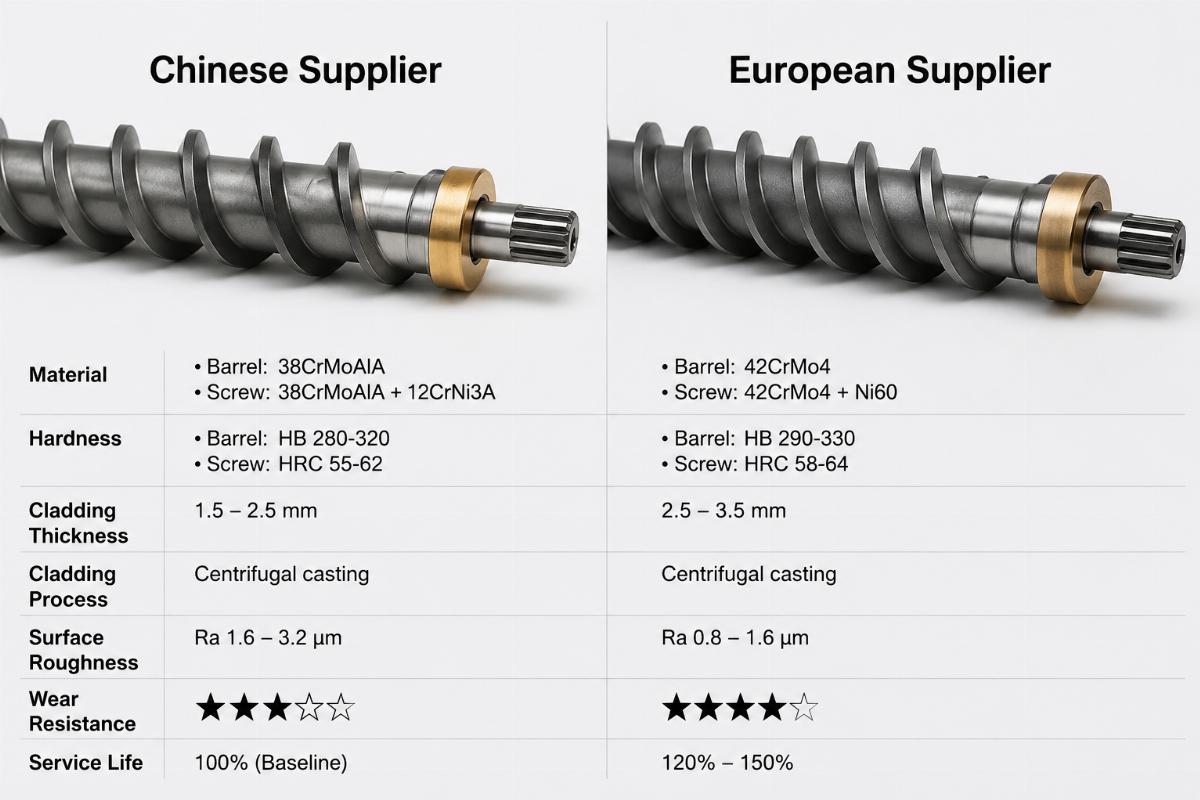
- Price Benchmark – Compare quotes against the 30-50% discount range relative to leading European brands like KraussMaffei and Battenfeld to identify overpriced options.
- Factory Direct Confirmation – Prioritize suppliers that own their full production facility in China rather than trading companies that source from third-party factories.
- Hidden Cost Check – Factor in warranty and support terms, not just upfront component price, to calculate total long-term ownership cost.
What common mistakes do buyers make when sourcing extruder wear parts?
Misjudging material matching and ignoring customization support are the top two errors that double long-term maintenance costs. Most operators treat extruder screws as generic interchangeable parts, which leads to premature wear and unnecessary spending on over-specified components that do not fit their actual use case.
| Common Mistake | Negative Outcome | Correct Approach |
|---|---|---|
| Assuming higher hardness equals longer life | Overpay for unnecessarily hard alloys that perform poorly with corrosive input materials like PVC | Prioritize alloy formula matched to your specific processing material, which reduces corrosion wear by 40% for PVC and recycled plastic [NEED_CITE: Material-matched bimetallic alloy formulas reduce corrosion wear by 40% for PVC processing] |
| Believing Chinese suppliers only support small orders | Miss out on bulk pricing and custom order capacity to meet tight project deadlines | Confirm minimum order terms and lead times for bulk custom orders before finalizing supplier selection |
| Treating screws as generic spare parts | Buy parts that cause 15% lower line efficiency and higher energy consumption per unit of output | Request custom screw configurations tailored to your line’s exact throughput and material type |
MT Extrusion Machinery Co., Ltd, a China-based manufacturer with 20 years of production experience, offers custom bimetallic screw solutions covering 45mm to 200mm diameters, designed to adapt to every common extrusion line application from PVC pipe production to plastic granulation. Their full line of components is backed by 2-year warranty and lifetime technical support, with free on-site engineer dispatch available for overseas installation support when needed.
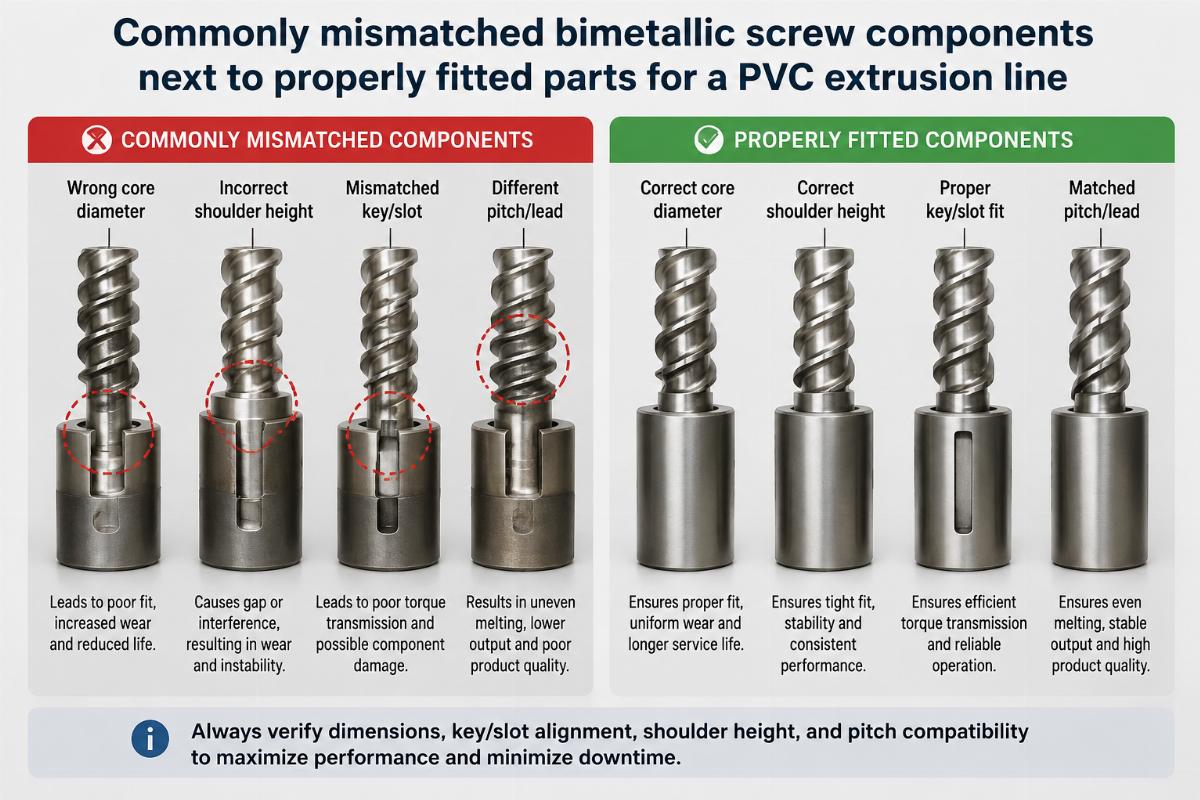
- Alloy Matching Review – Share your full input material mix and daily runtime data with suppliers to get a recommended alloy formula, not just a standard off-the-shelf part.
- Customization Check – Confirm suppliers can adjust screw flight depth, alloy layer thickness and other parameters to match your existing line’s output capacity.
- Long Term Cost Calculation – Run a 12-month maintenance cost projection using quoted part lifespan and replacement frequency to compare total costs across supplier options.
How to match bimetallic screw specifications to your existing extrusion line?
Parameter alignment based on material type and daily output reduces unnecessary over-specification costs by 20% on average. You do not need to purchase top-tier parts for low-throughput lines running clean, non-corrosive materials, and you do not need cheap generic parts for high-volume lines processing contaminated recycled waste.
| Line Parameter | Wrong Matching Practice | Correct Matching Practice |
|---|---|---|
| Throughput Range | Select the same part for all 500-2000kg/h lines regardless of exact capacity | Match screw channel depth and alloy layer thickness to your exact hourly output between 500 and 2000kg/h |
| Processing Temperature | Choose parts rated for temperatures far outside your normal operating range | Select alloy formulations tested to perform consistently at your line’s standard processing temperature |
| Input Material Purity | Use the same part for clean